


 Selling a house is an art in itself. An important part of the job is real estate communication. For houses in France this is a lot more complex than in many other European countries. The market in France is much less transparent, with real estate agents trying to outdo each other and also having to compete with both the notaries and their clients: the private sellers themselves. After all, many owners try to save 5 to 6% commission by finding a buyer themselves – without a broker.
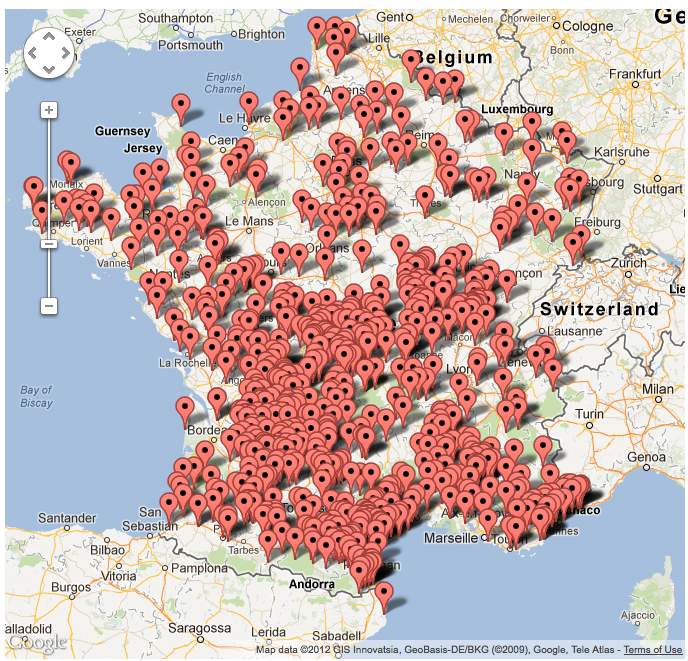
As a result of the fierce competition between brokers, there is no site that – like for instance Funda.nl in the Netherlands – makes the market almost 100% transparent. Real estate agents do not want to share their portfolio online without restrictions, for fear that their competitors will try to poach their clients.
Real estate communication is too much of an investment
Another important problem is that brokers in France are not prepared to invest in their clients. With a few exceptions, especially in the higher price ranges. We can see the lack of motivation from the presentations that the real estate agents produce in the field of real estate communication. Poor pictures, brief descriptions, no presentation advice, for example with home styling. In other countries this is much more evolved. As a result, all the houses on sites outside of France are neatly arranged and super clean on the photo, with only tasteful (and noncommittal) art on the walls.
Why don’t the
 A real estate agent in France costs the seller between 4% and – in the case of cheaper houses – as much as 10% of the selling price. While in the Netherlands as a seller you only pay 1% to 1.5%. Why is the estate agent so expensive in France? Does he or she deliver so much more quality? The sales advertisements produced by the real estate agents do not reflect this. A superior quality is obviously not the reason for the high price of the French broker. We will gladly explain it to you.
 Move to France and live like a Burgundian… now this might be possible even with a limited budget. Especially in view of the still relatively modest property prices in France. In the more rural areas, a sum less than a 100,000 euros will get you a very charming independent home sitting on a nice piece of land. This while many people in the UK own a house that has become much more valuable in the past ten years. A surplus value of a few hundred thousand pounds is no exception! This is why more and more people decide: “Cash in and check out! We are moving to France!” They sell their old house and
  If you are selling a property in France, the notary costs will be charged to the buyer. These costs are around 7 to 8% and consist largely of taxes. The notary himself is only allowed to keep a small portion of these fees. So he does not really earn a lot. Unless you’ve given the notary an official sales mandate and he actually comes up with the final buyer. In that case you as a seller will have to pay him an extra 3%… the so-called ‘frais de négociation’. The mandatory part, i.e. the fixed notary fees, is calculated as a percentage of the selling price. You can check the amount using the
  Are you buying a house in France, where real estate agents easily charge 5% and sometimes even more? Then it is certainly worth asking yourself whether you should maybe buy a house without a real estate agent. Depending on the selling price, the brokerage fees can add up considerably. The average price of a house in France is between 200,000 and 300,000 euros. So, at a commission rate of 5% you pay a brokerage fee of many thousands or euros. Of course, in itself it might not be a bad thing to pay a specialist for doing his or her job, as long as that job means that the numbers still add up. The question is what precisely a real estate agent does for